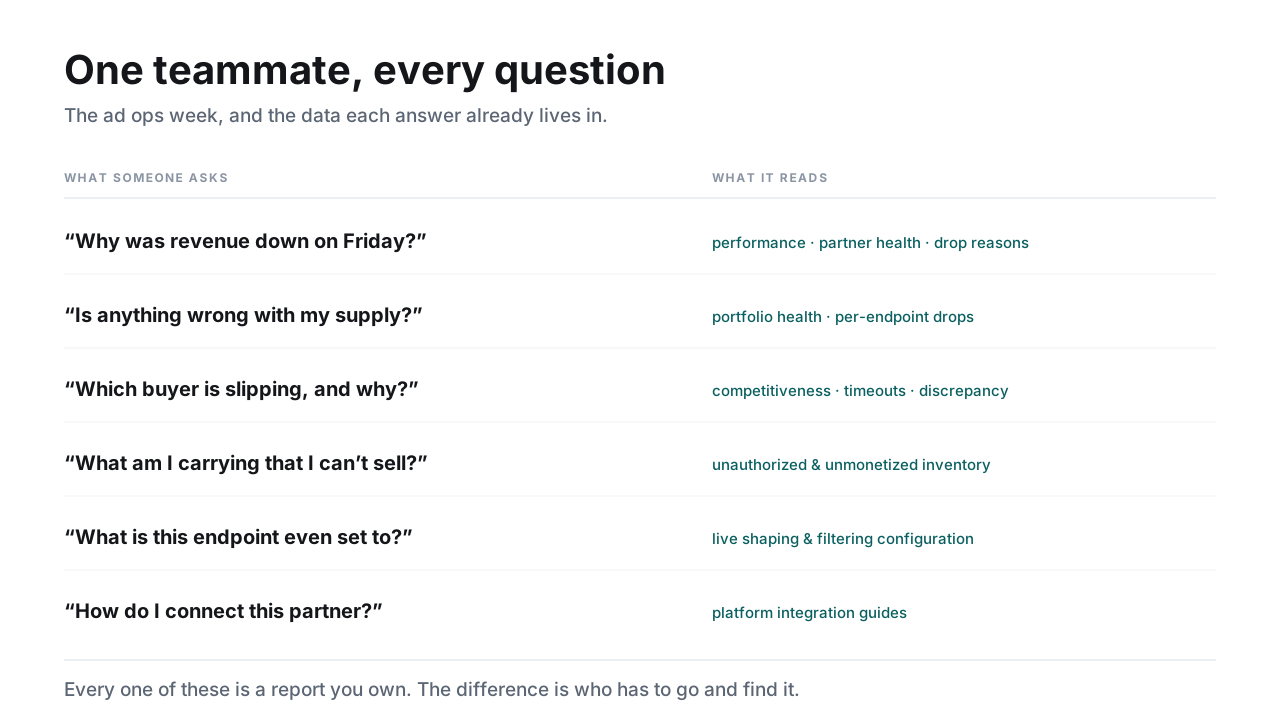
Ad operations is not really a technical job. It is a job made of questions.
Why did that endpoint earn less this week. Which buyer went quiet. Is that a real problem or a Tuesday. What are we carrying that we cannot legally sell. What is this endpoint even configured to do, and who set it that way. How do I connect the partner who signed on Friday.
Almost every one of those has an answer sitting in data you already own. The work is not deciding what to do — that part is usually obvious once you know what happened. The work is going and finding out what happened, over and over, across reports that are grouped differently and cannot be read side by side. That is where the hours go, and it is why ad ops teams are perpetually one person short.
This article is about what changes when there is an extra pair of hands for exactly that part: an assistant built into the exchange, with access to your own auction data, that can go and find out. Not a chatbot that summarizes the screen you were already looking at — a teammate you can hand a question to.
Table of Contents
- What “plus one” actually means
- Monday: what happened while you were away
- The drop nobody can explain
- Before a partner call
- The inventory audit nobody has time for
- What is this endpoint even set to?
- The new person’s first week
- What it will not do
- Getting good answers out of it
- Key takeaways
- The assistant on Floxis
- Sources worth bookmarking
What “plus one” actually means
The difference between a novelty and a colleague is not how well the thing writes. It is what it can go and look at.
A general chatbot can only reason about numbers you found and pasted in. It cannot check anything. Ask it why revenue fell and it will produce a confident list of plausible reasons, every one of which you already thought of, none of which it can test.
An assistant built into your exchange is given tools that query your auction data directly, and it chooses which to call and in what order based on what the last one returned. Ask it why revenue fell and it goes and looks: volume first, then which buyer, then whether that buyer changed everywhere or only here, then what filtered the requests. That is not a longer answer. It is a different kind of answer, because every step was checked against your data rather than guessed from the shape of the question.
The practical framing is a capable new team member who has read all the documentation, has instant access to every report, never gets bored of the fifth partner review of the day — and whose work you still check, the same way you would check anyone’s in their first month. That last clause is not a disclaimer. It is the operating model, and the rest of this article assumes it.
Monday: what happened while you were away
The most common ad ops task is also the least interesting: establishing whether anything needs attention.
Done properly this is a sweep — revenue and fill against last week, every supply endpoint for anything that fell off, every demand partner for anyone who went quiet, and a glance at whether request volume moved for reasons of its own. Done properly it takes half an hour, so in practice it gets done properly on Mondays and skipped by Thursday, which is how a partner who stopped bidding on Tuesday gets noticed the following week.
This is the task an assistant is best at, because it is well-defined, repetitive, and entirely data-bounded. “Compare this week to last across my endpoints and tell me what moved” is one question, and the answer arrives with the comparison already done.
One detail matters more than it looks. Period-over-period comparison has to be elapsed-aligned — today is a partial day, and comparing a partial day against a full one manufactures a decline of roughly ten to fifteen percent out of nothing. This is the single most common way a comparison lies, it is entirely mechanical, and an assistant that does the comparison inside the query rather than subtracting two separate reports gets it right every time. If you take one technical thing from this article, make it this one: ask your platform whether “versus last week” is elapsed-aligned, because if it is not, you have been reading a bias, not a trend.
The drop nobody can explain
Revenue on your video endpoint was down 18% on Friday. Nothing changed on your side.
You know the shape of the work, because it is the same every time. Was it fewer requests or the same requests earning less? If earning less — fewer bids, or cheaper bids? If fewer bids, from whom? Did that buyer go quiet everywhere, or only here? If only here, did the traffic change, or did they change their buying? And if requests were dropped before they ever reached an auction, which filter dropped them?
Six questions, six differently-grouped reports. An experienced person walks it in twenty minutes. Someone in their first month takes an afternoon and often stops at the first plausible answer, which is usually wrong — “partner X bid less” is a symptom, not a cause.
Handed to an assistant, the chain runs in one pass. Volume first: requests flat, so the traffic arrived and something downstream changed. Demand next: one buyer’s bid rate fell sharply while everyone else held steady, which kills the market-softness theory that would otherwise have cost you a day. Then the scoping question — is this buyer quiet everywhere or only on this endpoint — which separates a budget change on their side from something about your traffic. And finally drop reasons, which is where these investigations usually end: a filtering list edited three weeks ago that only started biting when the traffic mix shifted.
Every step is a query you could run yourself. The value is that they run in the order the evidence dictates, in one pass, with the intermediate numbers attached so you can check the reasoning instead of trusting the conclusion.
Before a partner call
The other recurring job is the one with a deadline attached: you have a call with a demand partner on Thursday and you need to know where you stand.
That means their bid rate and win rate over a sensible window, whether their timeout profile got worse, how competitive their bids are against the rest of your demand, whether your numbers and their numbers disagree, and how much of your total they represent — because a partner at 3% of revenue and a partner at 30% are different conversations even when the graph looks the same.
That is five reports and a spreadsheet, per partner, every time. It is also exactly the kind of preparation that gets skipped when the week is busy, which is how you end up on a call agreeing to something without knowing your own position.
An assistant with demand-side tools handles the assembly: partner health, competitiveness, timeout profile, discrepancy checks, concentration. What you bring is the part it cannot — the commercial history, what they promised last quarter, and what you actually want out of the call. It does the preparation. You do the negotiation.
The inventory audit nobody has time for
Some tasks are not hard, not urgent, and quietly expensive. Inventory hygiene is the canonical one.
Somewhere in your supply there is inventory you are carrying that is not authorized to be sold through you — a publisher who never added your line, a seller ID that does not resolve, a chain that does not validate. And somewhere else there is inventory that is authorized and simply is not earning: traffic arriving, requests going out, nothing coming back.
Neither shows up as an incident. Nothing pages you. It just sits there, and the longer it sits the more normal it looks, until a buyer’s supply-path team asks a question you cannot answer.
This is a good task to be able to ask for on a whim, because the barrier was never difficulty — it was that it takes twenty minutes and never becomes the most urgent thing on the list. “What am I carrying that is not authorized, and what is not earning” is a question you might ask once a quarter when it costs an afternoon, and once a week when it costs a sentence.
What is this endpoint even set to?
A category that sounds trivial and is not: what does my configuration currently say?
Any exchange running for a year accumulates settings nobody remembers making. A filtering list added for one bad publisher and never removed. A shaping intent set during an experiment. A QPS cap from when a partner asked, three quarters ago, and never revisited. Between what you think is configured and what is actually live there is always a gap, and every incorrect assumption in an investigation traces back to it.
An assistant that reads your live configuration closes that gap in a sentence, and — more usefully — reasons about the actual settings when it investigates something else. Half of “why is this endpoint underperforming” turns out to be a configuration answer, and the difference between an assistant that reads the config and one that assumes the defaults is the difference between finding that and confidently missing it.
The new person’s first week
The last one is about people rather than data.
Onboarding into an exchange is brutal. The vocabulary is dense, the causal chains are long, and most questions a new hire has are too small to interrupt someone over but too blocking to skip. So they either sit stuck or they interrupt the one person who knows, which costs that person their afternoon.
Two things help here. First, the platform’s own integration documentation, answered in place — “how do I connect this partner” resolved from the actual guide rather than improvised or half-remembered. Second, and more valuable, a place to ask the small questions without a social cost. Not because the answers are better than a colleague’s, but because they are available at eleven at night, and because nobody feels awkward asking the same clarifying question three times.
For a small operator this is a real part of the value, and it is the part nobody puts in a product brochure: the assistant’s biggest effect may be on how fast your second ad ops hire becomes useful.
What it will not do
Being straight about the edges is what makes the rest credible.
It does not make changes. It investigates, explains and recommends; you make the change. This is deliberate. A bad answer costs you five minutes, a bad action costs you a day of revenue, and those two risks should never ship as one decision.
It only sees your data. An exchange sits between parties who are not entitled to each other’s numbers, and that boundary is enforced where the data is fetched rather than requested in an instruction — the only way it can actually hold. Worth asking any vendor with an AI feature how they do this; if the answer describes what they told the model rather than what they filtered from the query, that is the answer.
It does not know the market. It knows your numbers cold and industry benchmarks not at all. Ask it whether your 42% fill rate is good and the right response is that it cannot know — and an assistant that invents a benchmark instead is one you cannot trust on the questions where you could not have checked.
It is not your reporting. Dashboards exist so anomalies are visible at a glance; asking for your daily revenue in a conversation makes a fast thing slow. The assistant earns its keep on the irregular question, not the standing one.
It is not the optimization engine. Answering “why did this drop” and continuously tuning floors against a live holdout are different problems. Conversation is the wrong control loop for a decision made ten thousand times an hour — that belongs in the auction path, measured against a control group. Anything claiming to optimize your yield by chatting with you is describing something that does not work.
Getting good answers out of it
The gap between a disappointing assistant and a genuinely useful one is mostly the question.
Name the window and the scope. “Compare last week to the week before across my video endpoints” gives it the comparison directly. “How are things going” gives it nothing, and it will guess.
Ask why, not what. “What was revenue Friday” is a report — open the report. “Why was revenue lower on Friday than Thursday” is an investigation, and investigation is the whole point.
Push one rung further. “Which buyer drove that, and was it fewer bids or lower prices” forces the next step rather than letting the first plausible answer stand. This is the single highest-value habit.
Open the report behind the answer. A good assistant hands you the underlying query, not just its conclusion. If the window or the grouping is not what you meant, you will see it in ten seconds — and that is the entire defence against acting on a right-shaped, wrong-scoped number.
Give it the boring jobs. The Monday sweep, the partner prep, the quarterly hygiene check. Not because they are hard, but because they are the ones that quietly stop happening.
Key takeaways
| Point | Detail |
|---|---|
| The bottleneck is finding out, not deciding | Ad ops decisions are usually obvious once you know what happened; the hours go into establishing what happened |
| Tools, not chat | The value is querying your own auction data and chaining the calls — a model summarizing a dashboard adds nothing |
| It is best at the jobs that get skipped | Monday sweeps, partner prep, inventory hygiene: well-defined, repetitive, and first to fall off a busy week |
| Elapsed-aligned comparison is non-negotiable | A partial day against a full one manufactures a 10–15% decline from nothing; ask how your platform does it |
| Read-only is the right default | It investigates and recommends; a human executes. Bad answer costs minutes, bad action costs a day |
| Confidentiality belongs in the data layer | Scoped and stripped where the query runs — an instruction telling a model to keep a secret is not a control |
| It does not know the market | Your numbers, yes. Industry benchmarks it should decline rather than invent |
| It shortens onboarding | The small questions get asked without a social cost, at any hour — often the biggest effect on a small team |
The assistant on Floxis
Floxis is a white-label RTB exchange you run as your own — your domain, your branding, your margin — and the AI assistant described here is included, available in the dashboard to every operator on the platform.
It answers from your own log-level auction data. The surface covers performance summaries and time series with elapsed-aligned period-over-period comparison built into the query; supply partner and portfolio health with the drop reasons behind them; demand partner health, competitiveness, timeout profiles, discrepancy checks and concentration; movement investigation scoped to the endpoints a partner actually runs on; inventory breakdowns including unmonetized and unauthorized inventory; your live traffic shaping and filtering configuration; and the platform’s own integration guides.
It is read-only — it investigates and recommends, and you make the change. Data-backed answers carry a deep link into the underlying report, so the query behind a conclusion is one click away and you can check the window, the grouping and the numbers yourself. Confidentiality is enforced where the data is fetched rather than asked for in a prompt, so a resale relationship stays confidential in both directions. And it stays in its lane: your platform, your data, ad tech concepts — anything else gets a one-line redirect rather than a confident guess.
Worth being clear about the division of labour, since the two get marketed as one thing. The assistant answers questions. The optimization engine makes decisions — you set an objective per endpoint and it blocks, scores and floors every auction toward it, running each lever from off to shadow to enforce against a live holdout, with a safety breaker that reverts enforcement the moment a test arm underperforms the control. One is how you understand your exchange; the other is how it improves without you. For the second, our guides to traffic shaping and what an exchange actually costs to run go deeper.
Book a technical walkthrough and bring a real question from your own operation — the fastest way to judge an assistant is to ask it something you already know the answer to.
Sources worth bookmarking
- IAB Tech Lab standards — the specifications your data has to keep speaking regardless of what sits on top of it
- OpenRTB 2.6 specification — the vocabulary most ad ops questions eventually bottom out in
- Prebid documentation — the integration surface behind a large share of onboarding questions
- OWASP Top 10 for Large Language Model Applications — worth reading before giving any assistant access to commercially sensitive data
- NIST AI Risk Management Framework — a workable vocabulary for governing an AI feature you did not build yourself